




Murata ADAS Noise Suppression Measures for 1000Base-T1
Today, sensors and cameras are being installed as devices for supporting advanced driver-assistance systems (ADAS). Although LVDS and other interfaces are being used for the transfer of camera data, automotive Ethernet is increasingly being used for the transfer of LiDAR and other sensor data. And while standards such as 100Base-TX and 1000Base-T are being used for office environments, standards such as 100Base-T1 and 1000Base-T1 are specified for use in automobiles.
ADAS Diagram

Signal Transmission by Automotive Ethernet
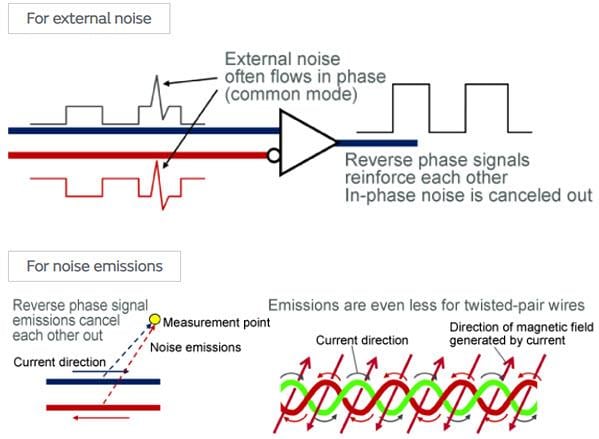
Ethernet and other automotive interfaces utilize differential transmission signals that offer minimal emissions and resist the effects of external noise. Because external noise often enters both differential transmission signal lines in the same manner, this does not affect their difference, and these lines feature strong resistance to external noise. Another advantage: Because the signal lines in the pair are adjacent, any magnetic field generated by signal currents are canceled out. Therefore, it is difficult for noise to be emitted externally.
Signal Transmission Diagram
Noise Issues in Automotive Ethernet
In differential transmission lines (where noise does not tend to be generated), noise issues can still occur when a common mode current is generated by a variety of factors.
Current Flow Diagram
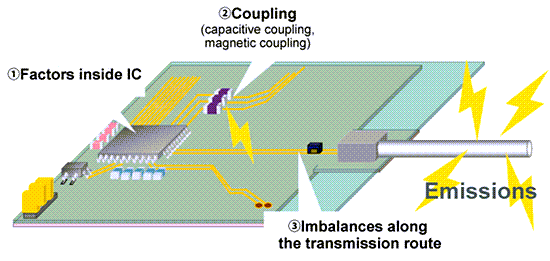
Common Mode Noise Factors
One characteristic of differential transmission lines is that common mode noise is typically not generated. But if skew (time difference) or an amplitude difference occurs in the signals between both lines, the signal balance between both lines will be lost. Therefore, common mode noise will be generated.
Signal Lines Diagram

Automotive Ethernet Noise Suppression
Ethernet Problems
There are differences between the cables used in Ethernet and the cables use for HDMI, USB, and other standards.
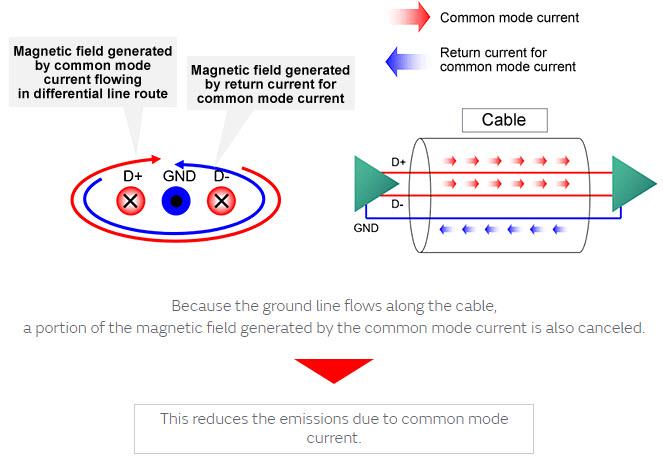
HDMI, USB, and similar cables feature a pair consisting of a signal line and a separate ground line. As a result, even if a common mode current flows, that current passes through the ground line and returns. Therefore, the magnetic field generated by the common mode current is canceled out, and noise emissions do not tend to occur.
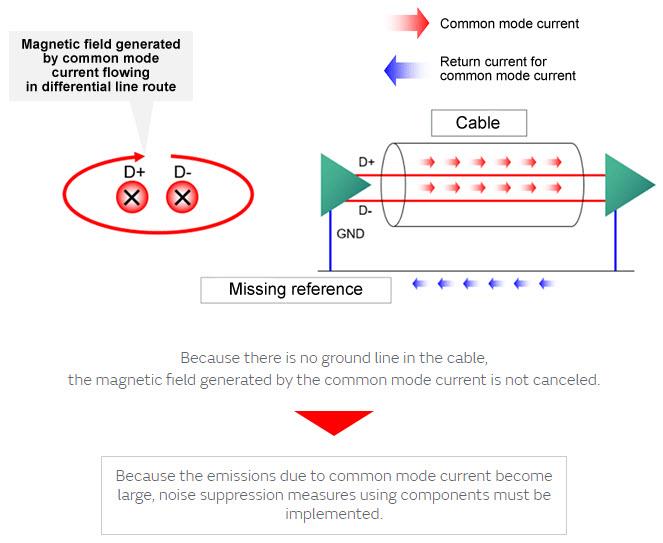
Ethernet cables, on the other hand, do not have a ground line. Therefore, the route where the common mode current returns is a ground that passes through stray capacitance, and noise emissions tend to be generated more easily.
Using HDMI, USB, & Similar Cables
Using Ethernet Cables
Common Mode Choke Coil
A common mode choke coil (CMCC) is effective in noise suppression measures for automotive Ethernet and other differential transmissions.
The choke coil is formed by winding two lines in opposite directions around a common core. The magnetic fluxes generated by both lines for the differential mode current cancel out each other, and there is no effect on the differential current. The magnetic fluxes generated by both lines for the common mode current reinforce each other and act as an inductor. Due to this action, common mode noise can be effectively attenuated without affecting the differential signals.
Choke Coil Diagram

Using CMCCs in Automotive Ethernet
The balance of the CMCC is important in automotive Ethernet. If there are any differences in the lengths or windings of the two lines comprising the CMCC, the current could become imbalanced. This could cause mode conversion and generate common mode noise. For this reason, a CMCC designed for maintaining the balance of both lines must be selected.
Murata's DLW32MH101XT2 CMCC is ideal for 1000Base-T1 noise suppression. It features an impedance value based on usage in 1000Base-T1 and offers a balanced design to prevent the occurrence of mode conversion.
Automotive Ethernet CMCCs

DLW32MH101XT2
The DLW32MH101XT2 CMCC provides three key elements:
• Effective for suppressing noise emitted from signal lines in automobile networks.
• Fully compatible with the 1000Base-T1 automotive Ethernet standard
• -40°C to +125°C operating temperature range for automotive applications
DLW32MH101XT2 Transmission Characteristics

Preventing Conducted Emission
Conducted Emission Measurement Conditions
The conducted emission was measured (150Ω method) using a 1000Base-T1 EMC test board.
Measurement Conditions

Comparison of Noise Attenuation Results
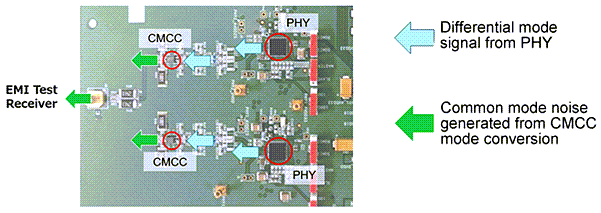
Common mode noise is conducted out from the signal line on the 1000Base-T1 EMC test board. Measurement is performed using an EMI receiver. In this study, the CMCCs were changed to compare the noise.
1000Base-T1 EMC Test Board

CMCC Used in Emission Tests
For test CMCCs, Murata used the DLW32MH101XT2 (CMCC for 1000Base-T1). For comparison, the DLW43MH201XK2 (CMCC for 100Base-T1) and the DLW32SH101XK2 (CMCC for CAN) were used.
Characteristics on 1000Base-T1 Board

Measurement Results
The results of the conducted emission measurements show that the DLW32MH101XT2 designed for 1000Base-T1 was most effective in reducing noise and satisfied the limit values. The DLW43MH201XK2 and DLW32SH101XK2 were unable to reduce the noise enough to satisfy the limit values.
Results Diagram

Noise Generating Mechanism
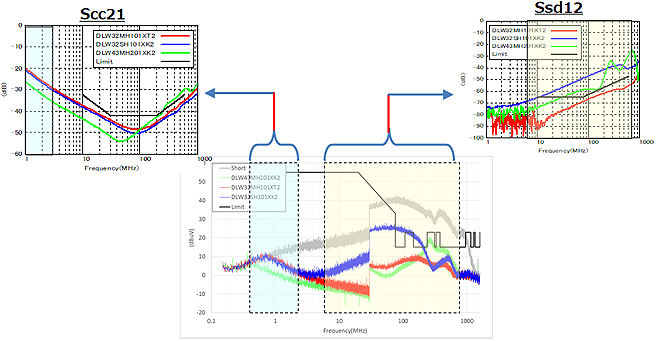
It is believed that one factor in the different noise suppression results by the CMCCs is the effect of the mode conversion characteristic Ssd12 of the CMCC (Figure 1, below). When the Ssd12 value is high, a high proportion of the differential mode signals that were input are converted to common mode noise. As a result, the noise level increased.
Figure 1
Noise Suppression Key Points
The conducted emission measurement results indicate how much common mode noise can be reduced by Scc21 at low frequencies. It also indicates how much of the amount converted to common mode can be reduced at high frequencies by the Ssd12 mode conversion characteristics.
Key Points Diagram
Notes on Board Design
The key points for board design were revealed through the CMCC evaluations (Figure 2, below). When the same CMCC sample for 1000Base-T1 was installed in the test board under the same conditions, the noise levels were different. A failing result also occurred in one of the boards. (Note: Failing results can be obtained for some statuses of the test board even when the CMCC samples are identical.)
When the transmission route characteristics on the board were analyzed, Murata found differences in the mode conversion characteristics at the CMCC output side and that the values for board #2 were high (Figure 3, below).
One likely factor in the different conducted noise levels by the boards was that the differential mode signals, after passing through the CMCC, were converted to common mode noise on the board (Figure 4, below).
The key points for the occurrence of mode conversion (Figure 5, below) include the resistor at the CMCC output side, capacitor, and board wiring. Imbalances are thought to arise due to variations in the characteristics of these components. For this reason, the sections other than the CMCC also require careful attention for maintaining the characteristic balance between the lines.
Figure 2
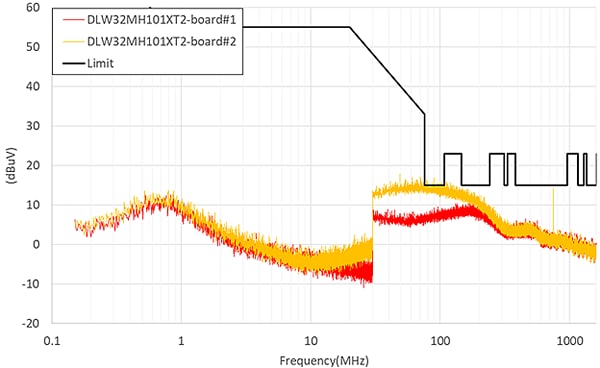
Figure 3

Figure 4

Figure 5

Conducted Emissions in 100Base-T1
When the same conducted emission measurements were performed for 100Base-T1, the limit values were exceeded when using the DLW32SH101XK2 for CAN. But the DLW43MH201XK2 designed for 100Base-T1 was effective enough in reducing noise to satisfy the limit values.
100Base-T1 Readings

100Base-T1 Vs. 1000Base-T1
The frequency component contained in the differential mode signal is different between 100Base-T1 and 1000Base-T1 (Figure 6, below). Therefore, the required mode conversion characteristics are also different. For this reason, a CMCC that was designed for meeting the respective standard must be selected.
Figure 6

Testing of Immunity (DPI) Measures
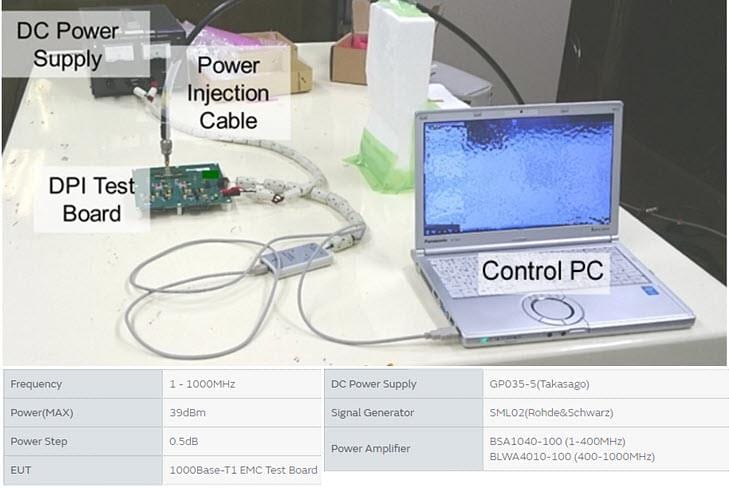
A Direct Power Injection (DPI) test was conducted using the same 1000Base-T1 EMC test board as the conducted emission.
Measurement Conditions
Testing Process
Common mode noise is conducted out from an external source to the signal line on the 1000Base-T1 EMC test board. A control PC is used to confirm whether any communication errors occurred.
CMCC on 1000Base-T1 Board

CMCC Used in DPI Tests
In the same way as the conducted emission, Murata used the DLW32MH101XT2 (CMCC for 1000Base-T1), DLW43MH201XK2 (CMCC for 100Base-T1), and DLW32SH101XK2 (CMCC for CAN) as test CMCCs.
Characteristics on 1000Base-T1 Board

1000Base-T1 DPI Test Results - 1
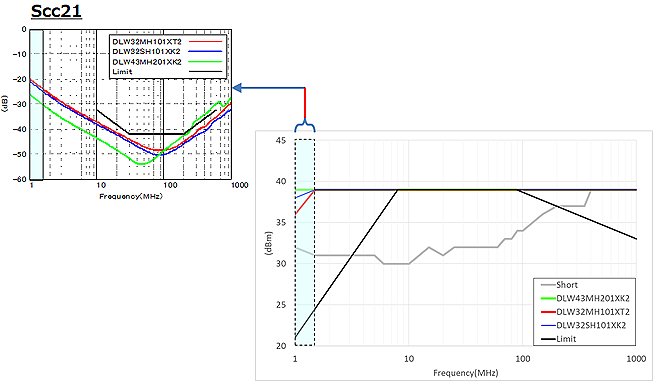
At low frequencies of 2MHz and less, the CMCCs exhibited differences in performance levels. However, for other frequencies, there was no difference in performance, and all CMCCs satisfied the limit values.
DPI Results Diagram - 1

1000Base-T1 DPI Test Results - 2
The differences in the CMCCs at 2MHz and less are believed to be due to common mode attenuation (Scc21). Differences in the mode conversion characteristics did not affect the results in the DPI test.
DPI Results Diagram - 2
Testing of Immunity (DPI) Measures Key Points
100Base-T1 DPI Test Results
After 1000Base-T1, the DPI test was also conducted for 100Base-T1. The CMCC for 100Base-T1 satisfied the limit values. However, the CMCC for CAN performed worse than the CMCC for 100Base-T1 at low frequencies of 1MHz and less. It also did not meet the limit values at 8MHz to 60MHz, and failed the test (Figure 7, below).
The differences at 2MHz and less are thought to be due to common mode attenuation (Scc21). Also, the differences at 8MHz to 60MHz are thought to be due to the mode conversion characteristics (Figure 7, below).
Figure 7

Figure 8

Noise Entry Mechanism
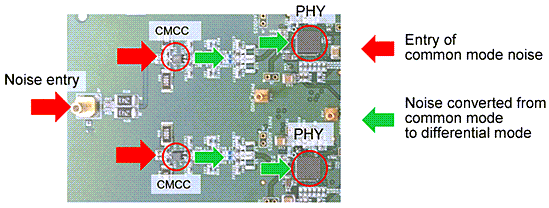
One factor as to why the mode conversion characteristics of the CMCC affected the test results for 100Base-T1 is that the common mode noise that entered from an external source was converted to differential mode noise. This process distorted the signal waveform, resulting in a communication error.
Communication Error Diagram
Notes on Board Design
In the same way as conducted emissions, in addition to the CMCC, this may also be caused by mode conversion due to imbalances on the board (Figure 9, below). Therefore, careful attention is needed in board design.
Figure 9

Conclusion
• For the automotive Ethernet standard 1000Base-T1, high performance is required in the CMCCs used for noise suppression. The mode conversion characteristics are particularly important.
• In the evaluation of conducted emissions, a CMCC having mode conversion characteristics that meet the required values for 1000Base-T1 is needed for suppressing noise. The limit values cannot be satisfied when using CMCCs for CAN or for 100Base-T1.
• Even in the CMCC for 1000Base-T1, mode conversion characteristics can worsen because of variations in the board design and installed components, resulting in extra noise. Therefore, careful attention to this point is necessary for the design process.
• In the DPI test, which is an immunity test, the required performance for the CMCC is lower than that for conducted emissions. But the noise resistance varies by the PHY. Therefore, the one with lower mode conversion characteristics is preferred.
Featured CMCCs
For 1000Base-T1: DLW32MH101XT2L
• Effective for suppressing noise emitted from signal lines in automobile networks.
• Fully compatible with the 1000Base-T1 automotive Ethernet standard
• -40°C to +125°C operating temperature range for automotive applications
For 100Base-T1: DLW43MH201XK2L
• 4.5mm (L) x 3.2mm (W) x 2.7mm (H), dimensional tolerance of ±0.2mm
• Provides common mode inductance of 200μH (at 0.1MHz) despite its compact size
• Significant improvement in mode conversion characteristics
SimSurfing Tool
Murata SimSurfing Tool
A free website design tool that provides information and data for selecting electronic components.
Community Forum
Murata Community Forum provides searchable content with various discussion topics, popular blogs, and articles. The Murata broad market support team holds regular reviews to discuss open issues, allowing inquiries to be answered in a timely manner. The forum content is freely accessible to the public. However, users must log in to post questions or answers. Registration is free of charge.
Learn More

Murata EMI Noise Suppression
Provides engineers with complete support, including products & design-simulation software solutions.
Related Products

Murata DLW Common Mode Choke Coils
Offers high impedance in the high-frequency band for more effective noise suppression.