




Murata Audio Line Noise Suppression for Home Audio
Digital amplifiers are becoming more popular for home audio applications and have improved in terms of audio quality. But because of the switching noise that occurs in digital amplifiers, noise that exceeds EMC standards can be emitted into the space around the cable connected to the speaker. Noise suppression via capacitors and inductors is typically implemented to solve this noise problem. But Murata has developed noise filters for audio lines that suppress unwanted noise while maintaining audio quality. Here is an overview of noise problems in home audio and their solutions.
Audio line problems in home audio
Inductors are generally introduced as EMI suppression components to suppress noise in electronic equipment. To ensure high quality in home audio applications, low distortion noise suppression products are required for the audio lines. In some cases, noise suppression is also needed for the power supply line to satisfy EMC standards (FIgure 1, below).
Figure 1
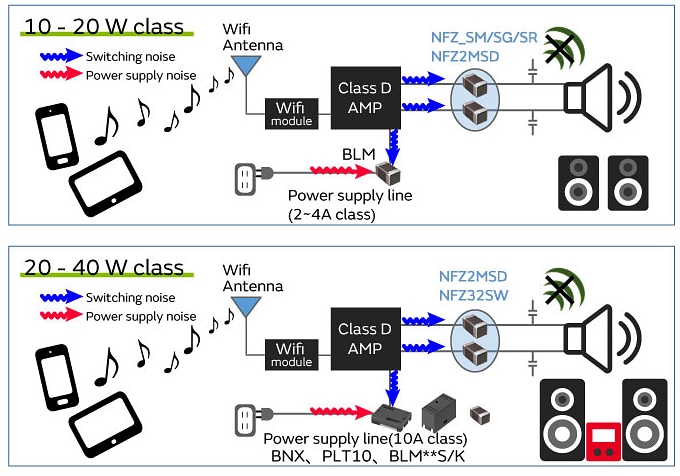
Product-use cases by output class
Characteristics & Performance
Audio Distortion Characteristics and Noise Suppression Performance in Audio Line Noise Filters
The audio distortion characteristics of common ferrite beads and Murata's NFZ_SD audio line filter are shown in Figure 2 (below).
While common ferrite beads display high audio distortion, this does not occur in the NFZ_SD series, which offers impedance characteristics that do not change even when a large current is flowing. This feature makes it possible to achieve noise suppression while maintaining audio quality without a filter.
Figure 2
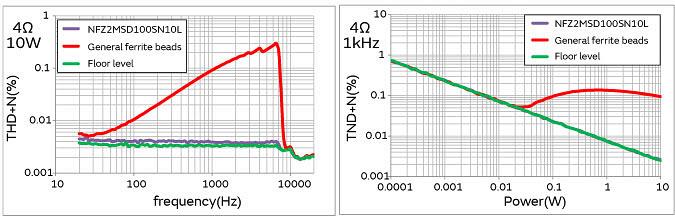
Audio characteristics (THD + N) of common ferrite beads and audio line filters
Benefits of noise suppression
Home audio speakers output very high volumes compared to smartphones and other mobile devices, so a large current (signal) flows through the noise suppression components. The characteristics of noise suppression products that use ferrite materials change when a current is flowing. Therefore, caution is necessary when making a selection.
As an example, Figure 3 (below) shows the changes in impedance characteristics of a noise suppression product when a current is flowing. The left side shows the characteristics of ferrite beads with a rated current of 5A, and the right side shows the Murata NFZ_SD series. NFZ_SD's impedance characteristics do not change even when a large current is flowing, so it is able to maintain noise suppression performance. Because the volume output from a speaker is not constant, it is necessary to use a filter with impedance characteristics that do not fluctuate for noise suppression.
Also, because the noise occurring in a digital amplifier has a spectrum of up to several 100MHz, suppression products with a high impedance in that band are effective. Murata NFZ_SD filters provide effective noise suppression while maintaining audio quality.
Figure 3
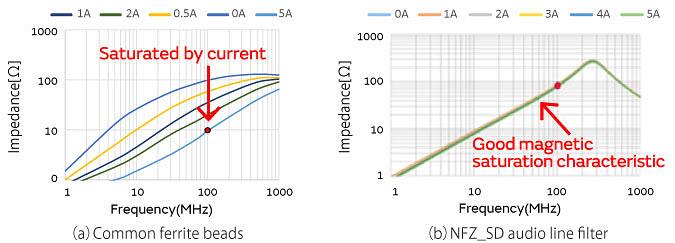
Frequency characteristics of common ferrite beads and audio line filters during DC superposition
Noise suppression examples
Suppression Example 1: Impact of the Speaker Cable Length
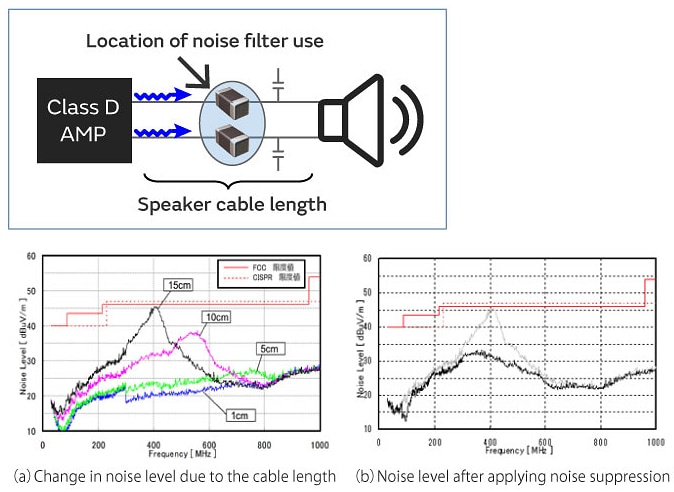
Home audio speakers range from conventional large speakers to smaller versions. The length of the speaker cable changes according to the size of the audio equipment, meaning noise levels change accordingly.
As an example, Figure 4(a) (below) shows the radiation noise level measurement results when the length of a speaker cable is changed. As the length increases, the noise level radiating from the cable also increases, so noise suppression is essential to clear noise regulations.
Figure 4(b) (below) shows the results after applying noise suppression. Noise regulations can be cleared by using the NFZ_SD audio line filter in the speaker line.
Figure 4
Block diagram of smartphone audio circuits
Suppression Example 2: Comparison with Common Ferrite Beads
Figure 5 (below) shows the results of measuring radiation noise when noise suppression is utilized in the Class D amplifier of a home audio device.
A Murata NFZ_SD audio line filter and common ferrite beads were used as suppression components.
While the NFZ_SD filter exhibits significant noise suppression effects even when a large current is flowing, the noise suppression of common ferrite beads is insufficient when the current value is large (2.4A). This results in noise radiation that exceeds the standard value.
This is due to the superposition characteristics of the component. The NFZ_SD series maintains effective noise suppression even when a large current is flowing, meaning it can be effective for radiation noise suppression in the audio lines of home audio equipment.
Figure 5

Radiation noise measurement results for a Class D amplifier
Recommended Audio Line Filter Products
As mentioned, it is important to avoid degrading audio quality while satisfying the target characteristics for noise level and reception sensitivity in audio line noise and isolation countermeasures.
In order to meet both requirements, Murata offers the NFZ and LQW series of audio line noise filters. Utilizing these audio line countermeasure components enables manufacturers to design smartphones equipped with miniature, high-quality audio circuits.
SimSurfing Tool

Murata SimSurfing Tool
A free website design tool that provides information and data for selecting electronic components.
Community Forum
Murata Community Forum provides searchable content with various discussion topics, popular blogs, and articles. The Murata broad market support team holds regular reviews to discuss open issues, allowing inquiries to be answered in a timely manner. The forum content is freely accessible to the public. However, users must log in to post questions or answers. Registration is free of charge.
Learn More

Murata EMI Noise Suppression
Provides engineers with complete support, including products & design-simulation software solutions.
Related Products

Murata Electronics NFZ Chip Noise Filters
Designed to suppress the noise of audio lines such as Class D amplifier, low DC resistance.
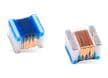
Murata Electronics LQW Wirewound Type Inductors
Offers a high Q value, giving them ideal attenuation characteristics inside the passband of filters.