




Murata Noise Suppression for Thunderbolt™ 3
Murata examines the Thunderbolt™ 3 noise and filters suitable for noise suppression. Thunderbolt is a high-speed digital interface developed by Intel Corporation and achieves communication speeds as high as 40Gbps. The Thunderbolt is designed from technology based on PCI Express and has been successively revised to Thunderbolt 3. The Thunderbolt 3 has been adopted as the standard specification for USB 4.0 and is expected to spread as a high-speed general-purpose interface.
What is Thunderbolt 3?

Figure 1. Comparison of data transfer rates of different interfaces
Alternate Method for Evaluation of Thunderbolt 3 Noise
Murata says it is difficult to obtain materials for the evaluation of Thunderbolt 3 noise, so the noise situation and noise suppression methods are estimated based on the data for USB 3.1 Gen 2, which is an interface that uses technology similar to Thunderbolt 3.
Comparison of technical requirements for Thunderbolt 3 & USB 3.1 Gen 2

Measurement of USB 3.1 radiation noise (Gen1 & Gen2)
Communication is performed using a USB 3.1-compatible SSD connected to a host PC, and the radiation noise is measured. (Measurement is performed in both the Gen1 and Gen2 operating modes.)
The noise level when an NFP0QHB542HS2 common mode choke noise filter is inserted into the USB Tx line as noise suppression is also checked. (Figure 2, below)
The main component of this noise is thought to be the common mode, so large suppression effects for the noise, observed at 5GHz and 10GHz, were obtained by inserting an NFP0QHB542HS2 common mode noise filter to the Tx line.
Figure 2

Figure 2. USB 3.1 Gen 1 and Gen 2 noise measurement results and confirmation of filter insertion effects
USB 3.1 Gen 1 communication: Narrowband noise (second-order harmonics) was observed at 5GHz, which is twice the signal fundamental frequency of 2.5GHz
USB 3.1 Gen 2 communication: Narrowband noise (second-order harmonics) was observed at 10 GHz, which is twice the signal fundamental frequency of 5GHz
Considerations regarding Thunderbolt 3
It is expected second-order harmonics of the communication signal frequency will be observed as narrowband common mode noise in Thunderbolt 3 communication, in the same manner as USB 3.1.
Thunderbolt 3 supports data transfer rates of 10Gbps/lane and 20Gbps/lane, so it is speculated that 10GHz and 20GHz common mode noise will occur with Thunderbolt 3.
Like USB 3.1, a common mode noise filter is effective.
Figure 3

Figure 3. Radiation noise expected for Thunderbolt 3
Effects of noise filters on Thunderbolt 3 signals
Signal integrity
Murata examined the effect of noise filters on Thunderbolt 3 signals. When a conventional noise filter was used, the eye pattern of the signal collapsed and did not satisfy the standard.
When the newly developed NFP0QHB542HS2 common mode choke coil was used, the eye pattern is maintained at a level that satisfied the standard.
This shows that when using noise filters with Thunderbolt 3, conventional filters should not be used, and products that support higher frequency signals should be chosen.
Figure 4
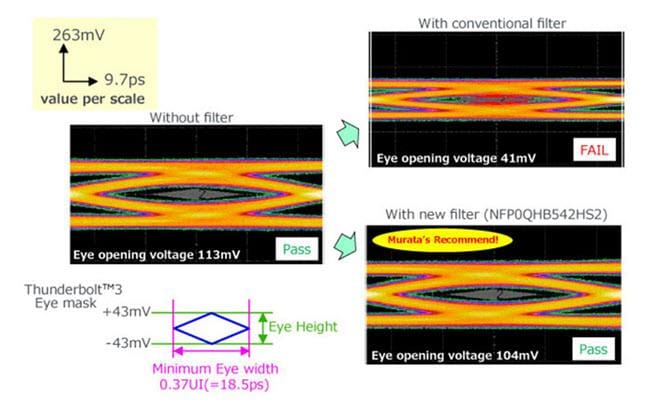
Figure 4. Effect of different filters on signal waveforms
Summary
Thunderbolt 3 is expected to become widespread due to its adoption in USB 4.0. Murata speculates Thunderbolt 3 noise will be similar to that of USB 3.1 Gen 1 and Gen 2 and that the key to Thunderbolt 3 noise suppression is to eliminate second-order harmonic common mode noise. Thunderbolt 3 uses high-speed signals, and sufficient care is needed so the filters used do not adversely affect the signal quality. Murata's NFP0QHB542HS2 common mode noise filter is commercialized for high-speed signals and can effectively eliminate second-order harmonic 10GHz and 20GHz common mode noise without a significant adverse effect on Thunderbolt 3 signal quality.
SimSurfing Tool

Murata SimSurfing Tool
A free website design tool that provides information and data for selecting electronic components.
Community Forum
Murata Community Forum provides searchable content with various discussion topics, popular blogs, and articles. The Murata broad market support team holds regular reviews to discuss open issues, allowing inquiries to be answered in a timely manner. The forum content is freely accessible to the public. However, users must log in to post questions or answers. Registration is free of charge.
Learn More

Murata EMI Noise Suppression
Provides engineers with complete support, including products & design-simulation software solutions.
Related Products
Intel Thunderbolt™ 3
Brings Thunderbolt to USB-C™ at speeds up to 40Gbps, creating one compact port that does it all.